






Published by Petal Healthcare | Nutraceutical & Ayurvedic Franchise Division
India’s nutraceutical market is at one of those rare inflection points where demand, awareness, and business opportunity have all converged at the same time. The pandemic fundamentally reshaped how Indians think about their health — not just reactively, but preventively. Immunity boosters, multivitamin combinations, herbal antioxidants, protein supplements, omega-3 formulations, and probiotic preparations have moved from being the concern of fitness enthusiasts to the everyday prescription vocabulary of general physicians, paediatricians, gynaecologists, and internal medicine specialists across Tier 1, Tier 2, and even Tier 3 markets. The Indian nutraceutical market, already valued at approximately ₹650 billion, is projected to grow at a CAGR of 15 percent through 2028. That growth doesn’t slow down, because the driver isn’t fashion — it’s a structural shift in how people understand preventive health.
Before comparing companies, it’s worth understanding what makes the nutraceutical franchise category distinct from general allopathic or even Ayurvedic PCD segments — because the business dynamics are different enough to matter.
For a franchise partner in the nutraceutical space, this translates into better inventory predictability, more stable monthly revenue, and the ability to build brand equity over time rather than constantly fighting for the next prescription cycle.
The nutraceutical manufacturing space in India is uniquely uneven in quality. Because nutraceuticals are regulated under both FSSAI (Food Safety and Standards Authority of India) and in some cases under the Drugs and Cosmetics Act (depending on formulation), the barrier to entry is lower than pure pharmaceutical manufacturing. That means the market carries both world-class operations and low-investment units printing impressive catalogues without the quality infrastructure to back them.
Here is the evaluation framework we recommend before committing to any nutraceutical manufacturing company:
| Evaluation Criterion | What to Look For | Red Flag |
| Certifications | WHO-GMP, ISO, FSSAI approval on product-level | Only state-level GMP, no product-specific approvals |
| Raw material sourcing | Standardised botanical/API extracts with COA documentation | Undisclosed or unverified ingredient sources |
| Product range depth | 100+ nutraceutical SKUs covering vitamins, minerals, herbals, protein, immunity | <50 products, mostly generic combinations |
| Formulation diversity | Tablets, capsules, softgels, powders, syrups, drops, sachets | Only one or two dosage forms |
| Monopoly rights | Written territory exclusivity, clearly defined geography | Verbal assurance only, no written agreement |
| Promotional support | Visual aids, product literature, MR bags, samples | Generic catalogue, no doctor-detailing support |
| Minimum order | Realistic first-order MOQ for distributor cash flow | Fixed large batches that lock up capital |
| Supply reliability | Committed dispatch timelines, dedicated account manager | No SLA, variable dispatch, poor reachability |
| Private label / third party | Option to launch your own brand through the same manufacturer | Only company brand, no white-label flexibility |
Using this table as a pre-shortlisting filter eliminates most of the noise. The companies that survive this screen are the ones worth comparing on price and product range.
The manufacturing and franchise supply base for nutraceuticals in India is concentrated in three main clusters: the Tricity region of Chandigarh–Panchkula–Mohali, the Baddi–Solan belt in Himachal Pradesh, and the Ahmedabad–Vadodara corridor in Gujarat. Ambala, where Petal Healthcare operates, sits at the geographic heart of the Haryana pharmaceutical cluster — close to Baddi’s manufacturing base, well-connected to North India distribution logistics, and adjacent to the Chandigarh pharma industry.
Here’s a comparative look at established nutraceutical franchise companies in India:
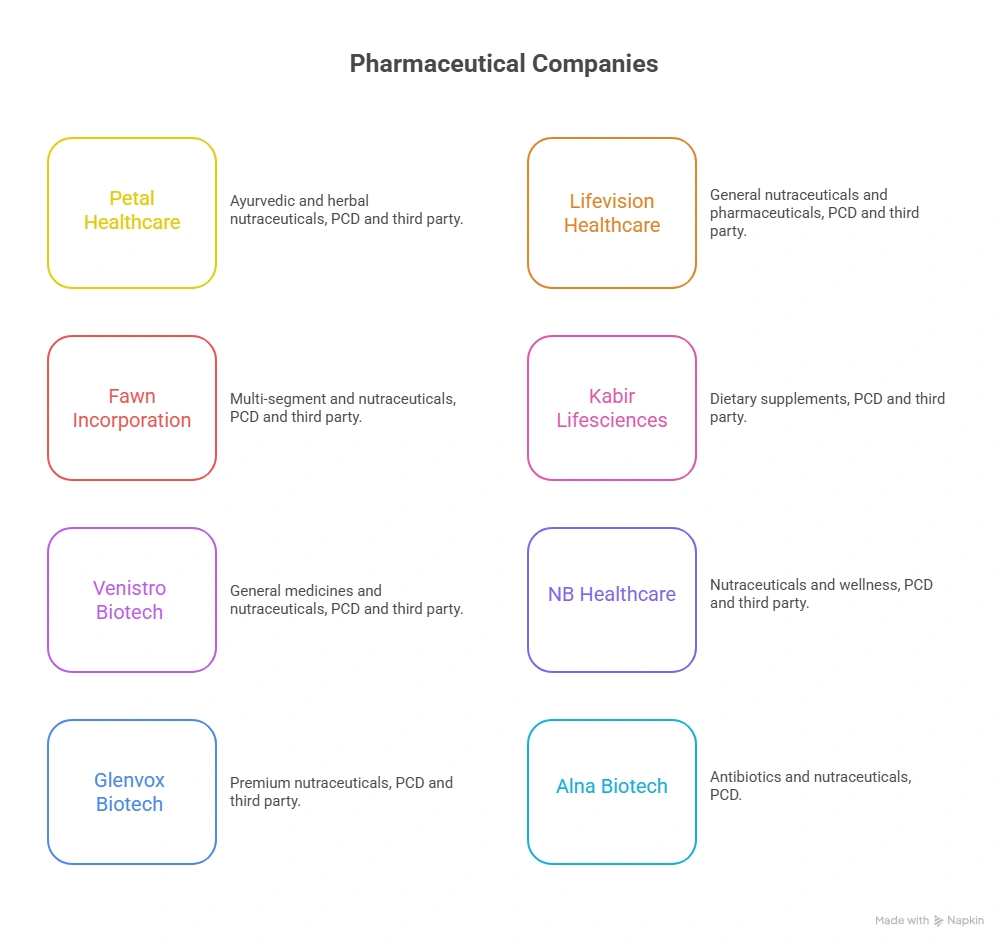
The density of quality nutraceutical franchise operators concentrated in the Haryana–Punjab–Chandigarh belt. What it also shows is the distinct positioning each company holds — Lifevision and Fawn have breadth of product numbers, while companies like Petal Healthcare and Glenvox carry more focused, quality-intensive Ayurvedic and herbal nutraceutical ranges. For a franchise partner targeting the preventive health and wellness segment rather than a general pharma portfolio, the focused herbal nutraceutical positioning is often the stronger commercial choice in prescriber-facing territory work.
One of the most common questions from first-time franchise enquiries is about the investment structure. Here’s an honest view of what nutraceutical franchise partnerships typically look like across different company tiers:
| Company Tier | Initial Investment Range | MOQ (First Order) | Batch/Product Pricing | Margin Profile |
| Entry-level PCD (product resellers) | ₹20,000 – ₹40,000 | Low, product-by-product | ₹30 – ₹150/unit | 20–30% |
| Mid-tier PCD (GMP-certified, 100–500 products) | ₹40,000 – ₹1,00,000 | Moderate | ₹100 – ₹500/unit | 30–45% |
| Quality-focused Herbal/Nutraceutical companies | ₹50,000 – ₹2,00,000 | Category-wise | ₹150 – ₹800/unit | 35–50% |
| Third-party / private label manufacturing | ₹1,00,000 – ₹5,00,000 | Per-batch (varies) | ₹560 – ₹5,000/batch | 50–70% (own brand) |
Investment figures are indicative of industry norms. Actual rates vary by company, product category, territory, and order frequency.
The most important observation in this table is the margin differential between reselling someone else’s brand versus building your own through a third-party manufacturing agreement with the same company. A franchise partner who begins with PCD distribution and later transitions to private label manufacturing through their franchise partner can see margin profiles double over a two-to-three-year period. Petal Healthcare’s model enables exactly this progression — we work with partners at both the PCD franchise level and the own-label manufacturing level, allowing you to grow within our ecosystem rather than having to switch manufacturers when your business scales.
The business case for a nutraceutical franchise is only as strong as the product range behind it. A company offering 50 multivitamin combinations and nothing else leaves you with limited prescriber reach. A well-structured nutraceutical portfolio should span:
At Petal Healthcare, our Ayurvedic and herbal heritage means our nutraceutical range goes significantly deeper into the herbal and botanical segment than most general pharma companies can match. Founded in 2015 by Jashmeet Khurana in Ambala with a philosophy rooted in combining Ayurvedic wisdom with modern manufacturing science, we have spent the last decade building a catalogue that covers everything from classical Ayurvedic formulations to contemporary nutraceutical combinations demanded by modern prescribers.
Our GMP and ISO-certified manufacturing facility ensures every product leaving our plant meets the quality standard that supports confident prescriber recommendation and retail consumer trust.
We’ve never believed in letting a product catalogue do the talking while the business support is thin. What we offer franchise partners and third-party manufacturing clients at Petal Healthcare is a complete commercial ecosystem — not just a price list.
For PCD franchise partners:
For third-party and private label clients:
Petal Healthcare’s position in Ambala gives our franchise partners in North India, Uttarakhand, UP, Delhi-NCR, Himachal, and Rajasthan one of the most logistically efficient supply chains in the nutraceutical segment — fast dispatch, reliable lead times, and no geographic dead zones in our coverage.
📩 Contact Petal Healthcare 📍 Ambala, Haryana — serving franchise partners PAN India
You need a valid Drug License (Form 20B and 21B for wholesale if selling Rx nutraceuticals) and GST registration. For FSSAI-regulated products, an FSSAI license may be required at the distributor level. We guide all Petal Healthcare franchise partners through the documentation process.
In most cases, yes — margin profiles in nutraceuticals typically run higher (35–55%) than generic allopathic medicines (20–35%), and the repeat purchase cycle is longer, creating more predictable monthly revenue.
Yes. We provide exclusive area-wise monopoly territory rights with a written agreement — your territory is protected from internal competition from other Petal Healthcare franchise partners.
Yes. Our third-party and loan licence manufacturing service allows complete private label customization. We handle manufacturing, quality certification, and batch documentation — you build and own your brand.
Investment ranges depend on the product categories you choose and your territory. Entry is accessible for first-time entrepreneurs and scalable for established distributors expanding into nutraceuticals. Contact our franchise team for a territory-specific quote.