





The global demand for natural wellness solutions has experienced unprecedented growth over the past decade. Consumers across the world are increasingly turning toward holistic healing systems, with traditional Indian medicine standing at the forefront of this transformation. Consequently, the wellness industry is witnessing a massive surge in demand for herbal formulations. However, launching or scaling a brand in this competitive landscape requires significant capital, infrastructure, and regulatory expertise. This is precisely where Ayurvedic medicine third party manufacturing becomes an invaluable business strategy for emerging startups, growing distributors, and established wellness enterprises.
By partnering with an experienced manufacturing partner, businesses can enter the herbal sector swiftly without making heavy investments in infrastructure, specialized machinery, or regulatory compliance teams. Therefore, outsourcing production allows brands to focus on marketing, brand positioning, and customer acquisition. In this comprehensive guide, we will explore everything you need to know about Ayurvedic medicine third party manufacturing, including how the process works, key benefits, quality standards, and how a trusted partner like Petal Healthcare can help bring your brand vision to life.
Before diving deeper into operational details, it is crucial to understand the fundamental concept. Ayurvedic medicine third party manufacturing—also commonly known as contract manufacturing or toll manufacturing—is a business arrangement where a brand owner contracts an independent, licensed manufacturer to produce herbal products under their own brand name.
In this model, the contract manufacturing company handles raw material sourcing, processing, formulation, production, quality control, and final packaging. Meanwhile, the client company retains complete ownership of the brand identity, trademark, and distribution rights.
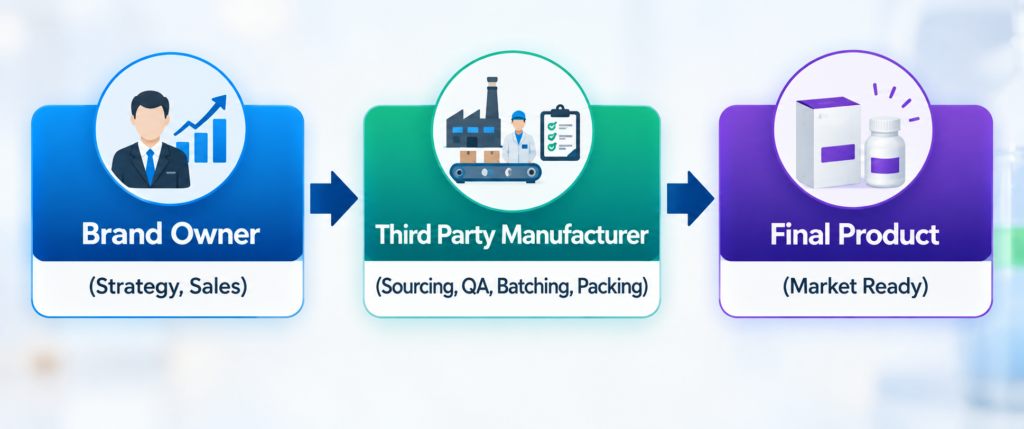
Furthermore, Ayurvedic medicine third party manufacturing enables companies to offer a diverse product portfolio—ranging from classical churnas and oils to modern capsules, syrups, and skincare preparations—without operating a physical factory. Consequently, this model lowers market entry barriers and streamlines supply chain management.
The operational process behind Ayurvedic medicine third party manufacturing is structured, transparent, and designed to ensure seamless execution. Here is a step-by-step overview of how the collaborative workflow typically unfolds:
First, the brand owner discusses product ideas, target markets, and specific formula expectations with the manufacturing team. For instance, you may choose from established pre-approved proprietary formulations or request custom development tailored to specific health needs.
Once the formulation and batch size are finalized, the manufacturer provides a comprehensive quotation covering raw material costs, manufacturing fees, packaging charges, and applicable taxes. Therefore, all financial expectations are clearly established before production begins.
In addition, statutory approvals are required before manufacturing any therapeutic product. The manufacturer assists with product approvals, license endorsements, and required paperwork under local herbal governing authorities.
Meanwhile, packaging designs, labels, and outer cartons are developed. The client provides branding guidelines, while the manufacturer verifies that label claims, ingredients, batch details, and warnings comply with statutory requirements.
After final artwork approval, raw materials undergo rigorous testing. Subsequently, full-scale production begins. Once batch testing confirms purity and safety, finished goods are packaged and dispatched directly to the brand owner.
Launching a proprietary manufacturing facility demands substantial capital investment, specialized machinery, real estate, and skilled labor. Moreover, navigating complex licensing regulations and maintaining ongoing compliance can quickly overwhelm new businesses. Consequently, choosing Ayurvedic medicine third party manufacturing presents a practical, cost-effective alternative.
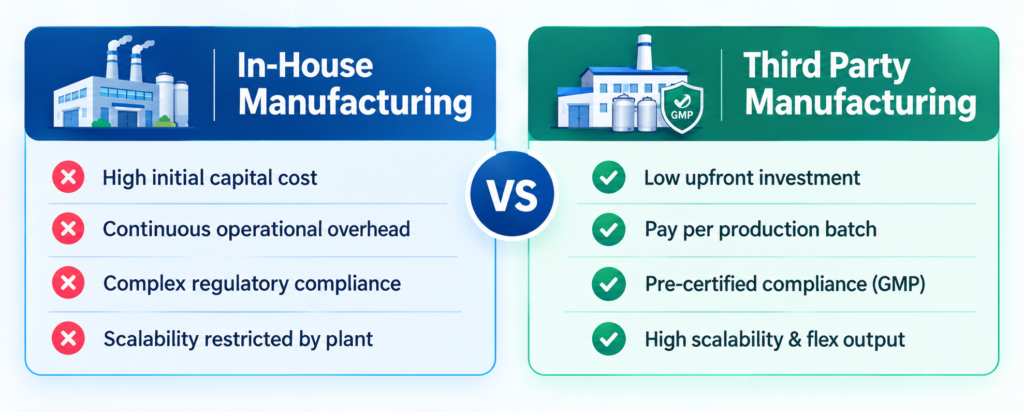
Furthermore, partnering with established specialists provides immediate access to seasoned herbal formulators, advanced extraction methods, and certified testing facilities. As a result, businesses reduce operational risk while delivering premium, authentic products to their customers.
For startups, entrepreneurs, and established market players, adopting an Ayurvedic medicine third party manufacturing strategy offers multiple distinct advantages:
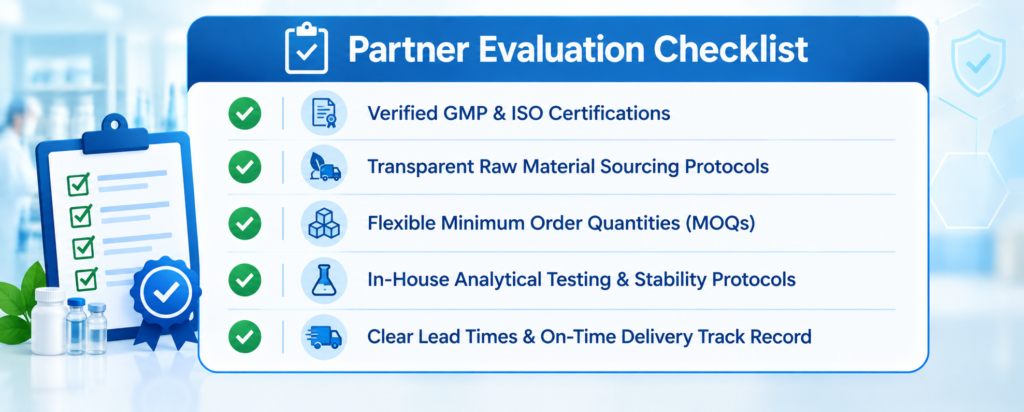
Selecting the right partner for Ayurvedic medicine third party manufacturing is crucial to long-term business success. Because product quality directly affects your brand reputation, consider the following key factors before finalizing an agreement:
First and foremost, verify that the manufacturing facility holds current certifications, such as Good Manufacturing Practices ( GMP ). Additionally, check that the facility complies with relevant state and national drug control regulations.
Furthermore, ensure the manufacturer possesses modern machinery capable of producing your desired dosage forms—whether capsules, tablets, classical syrups, herbal teas, or topical ointments.
The efficacy of traditional herbal formulations depends entirely on plant quality. Therefore, ask detailed questions regarding herb sourcing, extraction techniques, and raw material purity tests.
In addition, request clear information regarding batch sizes and MOQs. A transparent partner provides flexible MOQs to help startups launch without excessive inventory holding costs.
Maintaining uncompromising quality control is essential in Ayurvedic medicine third party manufacturing. Because natural botanical ingredients exhibit natural variations, stringent standardized testing is required at every production stage.
At Petal Healthcare, strict adherence to GMP standards ensures every tablet, capsule, and liquid extract meets stringent quality, safety, and purity guidelines.
In the competitive herbal market, packaging is just as important as formulation quality. Therefore, a comprehensive Ayurvedic medicine third party manufacturing service encompasses end-to-end support for custom formulation, packaging design, and legal labeling.
Manufacturers offer diverse packaging options designed to preserve herbal active ingredients while creating visual appeal on retail shelves:
Besides aesthetic appeal, labels must strictly adhere to regulatory guidelines. For example, product labels must clearly list active ingredients, manufacturing license details, batch numbers, manufacturing/expiry dates, and dosage instructions.
When searching for a trusted leader in Ayurvedic medicine third party manufacturing, Petal Healthcare stands out as a reliable industry partner. Combining rich traditional herbal heritage with state-of-the-art technological capabilities, Petal Healthcare helps businesses turn creative ideas into market-leading commercial products.
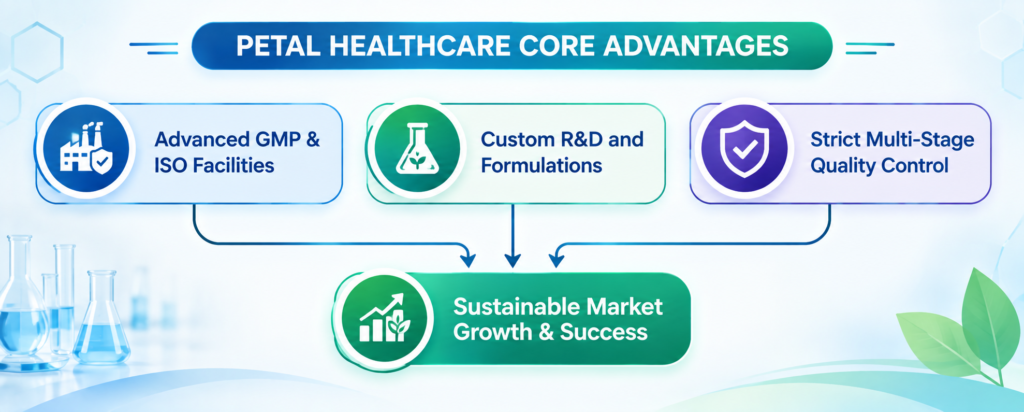
Consequently, partnering with Petal Healthcare gives your brand a distinct competitive advantage in today’s fast-growing herbal market.
Beyond basic manufacturing services, Petal Healthcare serves as a strategic growth catalyst for client brands. For instance, whether you are an emerging startup introducing your first product line or an established brand expanding your retail catalog, Petal Healthcare offers scalable solutions tailored to your operational budget.
Furthermore, transparent communication, predictable production schedules, and reliable lead times ensure your retail partners never face inventory shortages. In addition, the technical support team at Petal Healthcare assists with ongoing regulatory compliance and packaging updates as statutory guidelines evolve. As a result, businesses can focus on expanding sales networks while Petal Healthcare seamlessly handles end-to-end production operations.
A: Ayurvedic medicine third party manufacturing is a contract arrangement where a brand hires a licensed third-party manufacturer to formulate, produce, test, and package herbal products under the brand’s own name and label.
A: Yes, appropriate state or central regulatory approvals and marketing licenses are required. However, the third-party manufacturer holds the underlying manufacturing license and provides essential support for registering your product endorsements.
A: Petal Healthcare maintains strict adherence to Good Manufacturing Practices (GMP). Furthermore, all raw herbs undergo comprehensive testing for heavy metals, pesticides, microbial levels, and active marker compounds before production begins.
A: Yes, Petal Healthcare features a dedicated Research & Development team that collaborates with clients to develop custom herbal formulations tailored to target health benefits and market needs.
A: Manufacturers provide a wide range of options including blister packs, bottle packaging (glass and PET), HDPE containers, strip packaging, airless pump jars, and customized outer cartons.
A: Third-party manufacturing eliminates the high capital costs associated with land acquisition, machinery purchase, facility maintenance, and operational overhead, allowing businesses to optimize their capital allocation.
The market for natural, plant-based remedies is expanding rapidly across global markets. However, building a successful brand requires balancing operational efficiency, uncompromised quality, and regulatory compliance. Ayurvedic medicine third party manufacturing offers the ideal solution for businesses looking to market high-grade herbal remedies efficiently without the heavy burden of factory management.
By choosing a dedicated manufacturing partner like Petal Healthcare, you gain access to state-of-the-art manufacturing infrastructure, rigorous quality assurance, custom formula formulation, and scalable production capacity. Consequently, your brand can establish a strong market presence and build lasting consumer trust. Contact Petal Healthcare today to discuss your contract manufacturing needs and take your business to the next level.